A detailed STLBEAST repair guide to store materials according to moisture sensitivity and use frequency. Learn how to recognize the symptom, rank the likely causes, apply safe fixes in order, verify the result, and prevent the failure from returning.
Start hereStart with use sealed containers, then monitor humidity. Confirm the result with a short representative test before changing additional settings.
First safe actionRun the first safe check and change one variable at a time.
Proof targetA small representative test no longer shows the original symptom.
Match the failed area to the visual before changing a setting.
Repair progress0 of 8 complete
Step 1 of 8
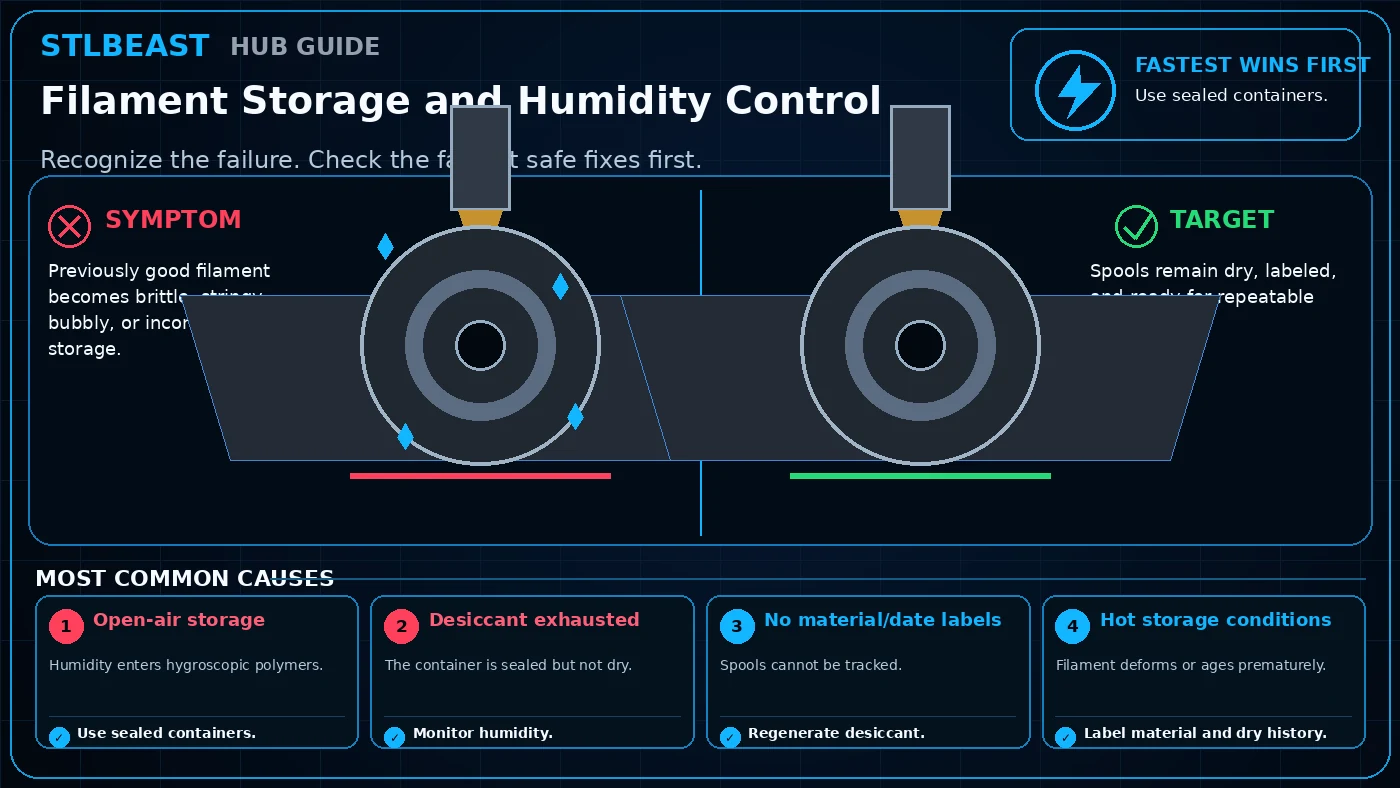
Document the failure and confirm that it matches this guide: Previously good filament becomes brittle, stringy, bubbly, or inconsistent in storage.
Keep the problem and target visual open while you make this change.
Why this matters
Humidity enters hygroscopic polymers.
Setting or checkTemperature
Start with the exact manufacturer range for the specific blend.
Expected result
Spools remain dry, labeled, and ready for repeatable printing.
Step 2 of 8
Return extreme overrides to a known printer, nozzle, material, and slicer profile so the diagnosis starts from a stable baseline.
Keep the problem and target visual open while you make this change.
Why this matters
The container is sealed but not dry.
Setting or checkDrying/storage
Moisture control is part of the print profile.
Expected result
The same test succeeds at least twice without a new artifact appearing.
Step 3 of 8
Check open-air storage. Use sealed containers.
Keep the problem and target visual open while you make this change.
Why this matters
Spools cannot be tracked.
Setting or checkSpeed
Filled, flexible, or high-temperature materials often need slower flow.
Expected result
No safety warning, unusual noise, heater error, binding, or material damage is introduced by the change.
Step 4 of 8
Check desiccant exhausted. Monitor humidity.
Keep the problem and target visual open while you make this change.
Why this matters
Filament deforms or ages prematurely.
Setting or checkHardware compatibility
Confirm nozzle wear, hotend temperature, enclosure, and ventilation requirements.
Expected result
The successful values are recorded with printer, nozzle, material, slicer, and date.
Step 5 of 8
Inspect no material/date labels. Regenerate desiccant.
Keep the problem and target visual open while you make this change.
Why this matters
Humidity enters hygroscopic polymers.
Setting or checkTemperature
Start with the exact manufacturer range for the specific blend.
Expected result
Spools remain dry, labeled, and ready for repeatable printing.
Step 6 of 8
Rule out hot storage conditions. Label material and dry history.
Keep the problem and target visual open while you make this change.
Why this matters
The container is sealed but not dry.
Setting or checkDrying/storage
Moisture control is part of the print profile.
Expected result
The same test succeeds at least twice without a new artifact appearing.
Step 7 of 8
Change only the single setting or hardware condition supported by the evidence, then run a small test that reproduces the original failure.
Keep the problem and target visual open while you make this change.
Why this matters
Spools cannot be tracked.
Setting or checkSpeed
Filled, flexible, or high-temperature materials often need slower flow.
Expected result
No safety warning, unusual noise, heater error, binding, or material damage is introduced by the change.
Step 8 of 8
Compare the test against the target condition, record the successful value, and save it in a printer/material profile before repeating the full print.
Keep the problem and target visual open while you make this change.
Why this matters
Filament deforms or ages prematurely.
Setting or checkHardware compatibility
Confirm nozzle wear, hotend temperature, enclosure, and ventilation requirements.
Expected result
The successful values are recorded with printer, nozzle, material, slicer, and date.
Controlled test log
Change one variable, then record what happened
This keeps temperature, retraction, speed, mechanical, and material tests from blending together. The history stays private in this browser.