A detailed STLBEAST repair guide to identify random versus repeating layer variation. Learn how to recognize the symptom, rank the likely causes, apply safe fixes in order, verify the result, and prevent the failure from returning.
Start hereStart with check whether pattern repeats, then inspect z travel. Confirm the result with a short representative test before changing additional settings.
First safe actionRun the first safe check and change one variable at a time.
Proof targetA small representative test no longer shows the original symptom.
Match the failed area to the visual before changing a setting.
Repair progress0 of 8 complete
Step 1 of 8
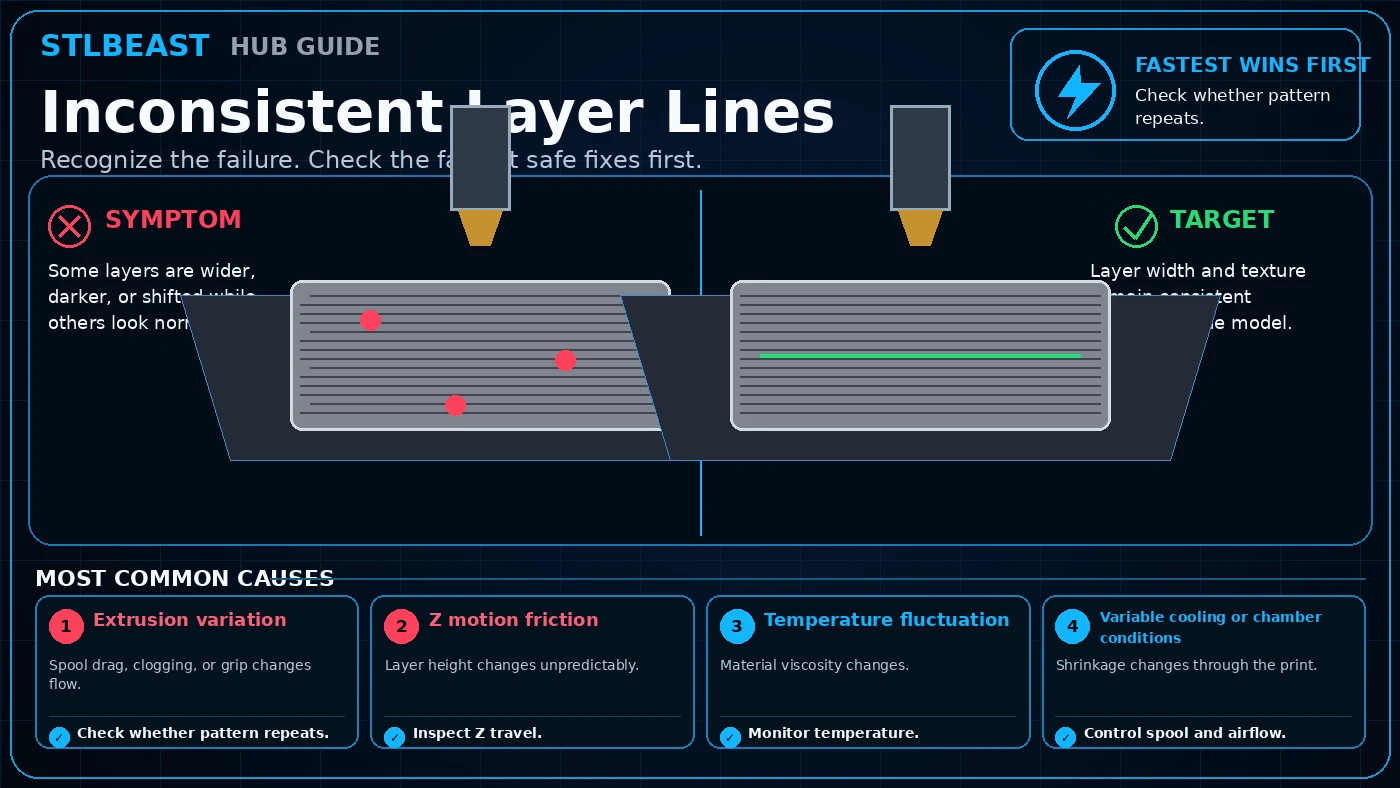
Document the failure and confirm that it matches this guide: Some layers are wider, darker, or shifted while others look normal.
Keep the problem and target visual open while you make this change.
Why this matters
Spool drag, clogging, or grip changes flow.
Setting or checkOuter-wall speed
Use a stable quality speed before changing many other values.
Expected result
Layer width and texture remain consistent throughout the model.
Step 2 of 8
Return extreme overrides to a known printer, nozzle, material, and slicer profile so the diagnosis starts from a stable baseline.
Keep the problem and target visual open while you make this change.
Why this matters
Layer height changes unpredictably.
Setting or checkTemperature
Too hot softens details; too cold weakens flow and bonding.
Expected result
The same test succeeds at least twice without a new artifact appearing.