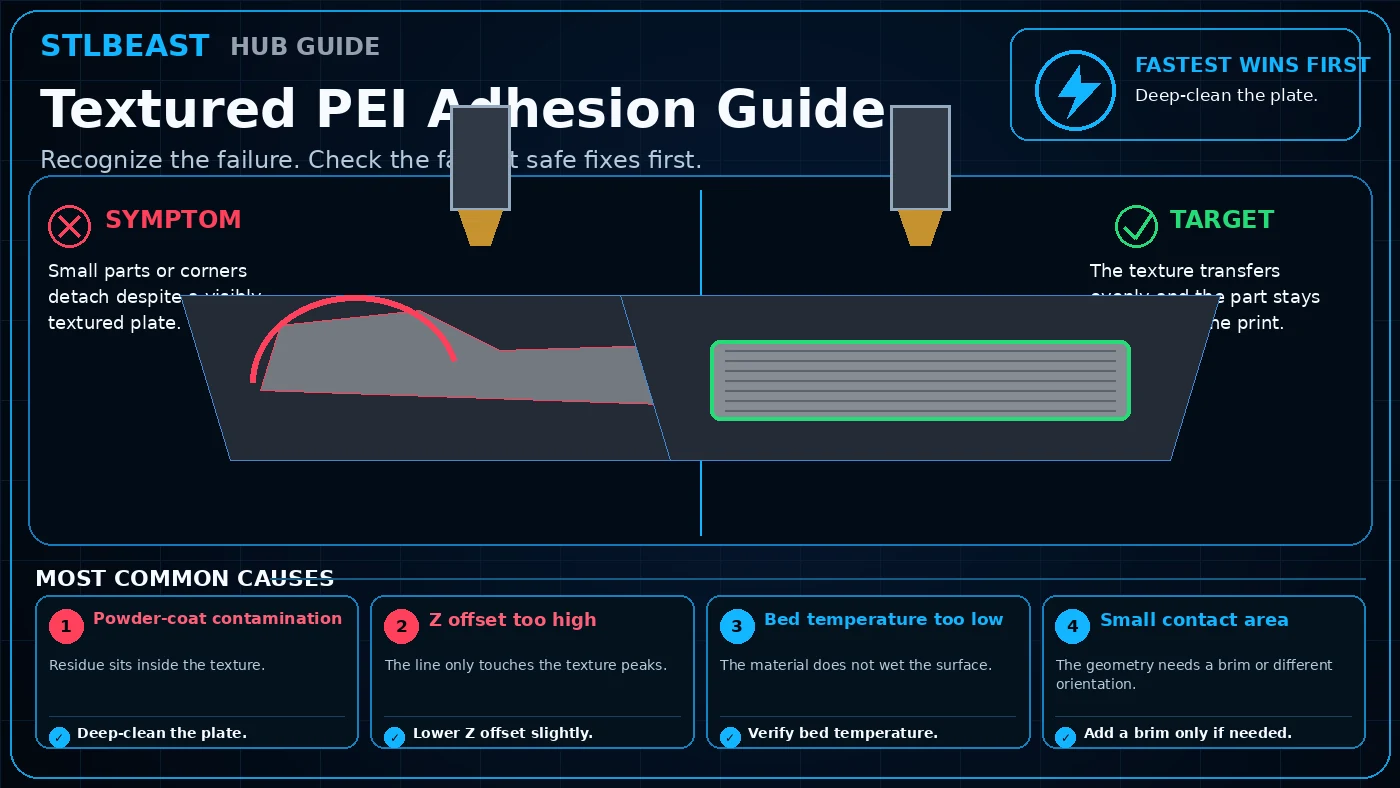
A detailed STLBEAST repair guide to improve textured-plate grip without excessive squish. Learn how to recognize the symptom, rank the likely causes, apply safe fixes in order, verify the result, and prevent the failure from returning.
Start hereStart with deep-clean the plate, then lower z offset slightly. Confirm the result with a short representative test before changing additional settings.
First safe actionRun the first safe check and change one variable at a time.
Proof targetA small representative test no longer shows the original symptom.
Match the failed area to the visual before changing a setting.
Repair progress0 of 8 complete
Step 1 of 8
Document the failure and confirm that it matches this guide: Small parts or corners detach despite a visibly textured plate.
Keep the problem and target visual open while you make this change.
Why this matters
Residue sits inside the texture.
Setting or checkZ offset
Tune only after cleaning and leveling; use very small changes.
Expected result
The texture transfers evenly and the part stays flat through the print.
Step 2 of 8
Return extreme overrides to a known printer, nozzle, material, and slicer profile so the diagnosis starts from a stable baseline.
Keep the problem and target visual open while you make this change.
Why this matters
The line only touches the texture peaks.
Setting or checkFirst-layer speed
Slow enough to bond before direction changes pull the line.
Expected result
The same test succeeds at least twice without a new artifact appearing.
Step 3 of 8
Check powder-coat contamination. Deep-clean the plate.
Keep the problem and target visual open while you make this change.
Why this matters
The material does not wet the surface.
Setting or checkFirst-layer temperature
Stay inside material and surface limits.
Expected result
No safety warning, unusual noise, heater error, binding, or material damage is introduced by the change.
Step 4 of 8
Check z offset too high. Lower Z offset slightly.
Keep the problem and target visual open while you make this change.
Why this matters
The geometry needs a brim or different orientation.
Setting or checkCooling
Delay or reduce early fan when the material requires it.
Expected result
The successful values are recorded with printer, nozzle, material, slicer, and date.
Step 5 of 8
Inspect bed temperature too low. Verify bed temperature.
Keep the problem and target visual open while you make this change.
Why this matters
Residue sits inside the texture.
Setting or checkZ offset
Tune only after cleaning and leveling; use very small changes.
Expected result
The texture transfers evenly and the part stays flat through the print.
Step 6 of 8
Rule out small contact area. Add a brim only if needed.
Keep the problem and target visual open while you make this change.
Why this matters
The line only touches the texture peaks.
Setting or checkFirst-layer speed
Slow enough to bond before direction changes pull the line.
Expected result
The same test succeeds at least twice without a new artifact appearing.
Step 7 of 8
Change only the single setting or hardware condition supported by the evidence, then run a small test that reproduces the original failure.
Keep the problem and target visual open while you make this change.
Why this matters
The material does not wet the surface.
Setting or checkFirst-layer temperature
Stay inside material and surface limits.
Expected result
No safety warning, unusual noise, heater error, binding, or material damage is introduced by the change.
Step 8 of 8
Compare the test against the target condition, record the successful value, and save it in a printer/material profile before repeating the full print.
Keep the problem and target visual open while you make this change.
Why this matters
The geometry needs a brim or different orientation.
Setting or checkCooling
Delay or reduce early fan when the material requires it.
Expected result
The successful values are recorded with printer, nozzle, material, slicer, and date.
Controlled test log
Change one variable, then record what happened
This keeps temperature, retraction, speed, mechanical, and material tests from blending together. The history stays private in this browser.