Cooling & FansIntermediate13 minReviewed 2026

Hotend Heatsink Fan Not Spinning

Stop long prints until the heatsink fan is restored; clean the fan, check its connector and voltage, confirm firmware control, and replace a noisy or stalled un.

Fast answer

Stop long prints until the heatsink fan is restored; clean the fan, check its connector and voltage, confirm firmware control, and replace a noisy or stalled unit.

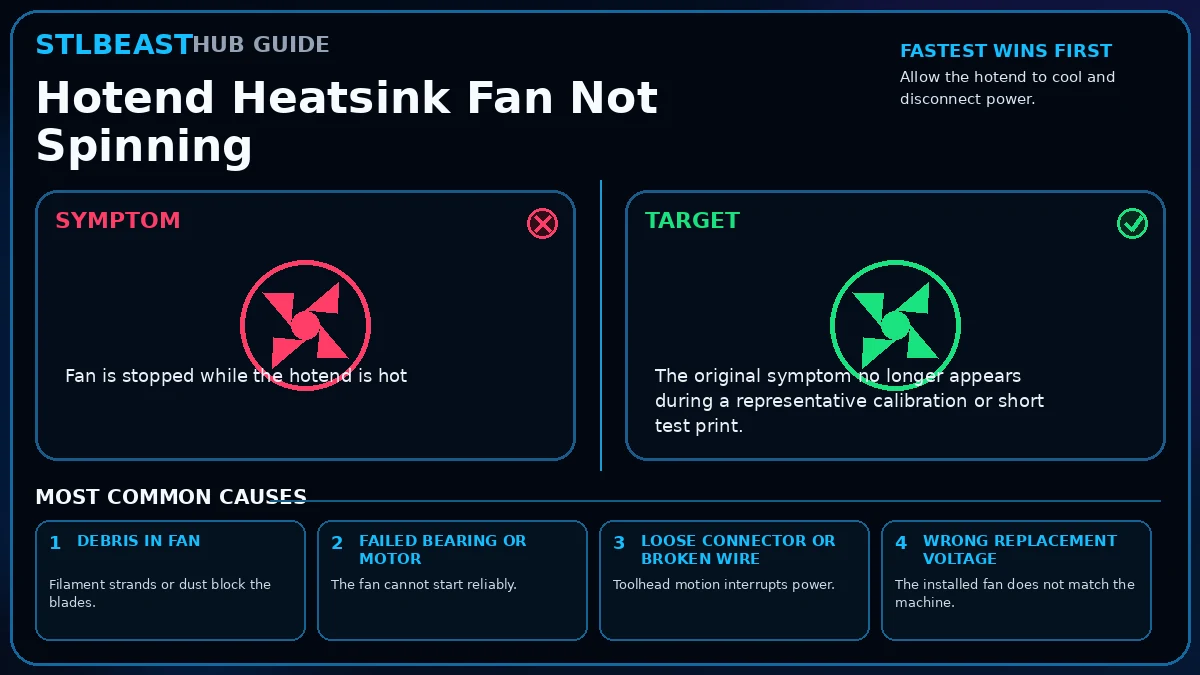
Visual diagnosis for hotend heatsink fan not spinning
Compare the symptom and target, then follow the ranked checks.

Before you change settings

  • Confirm the exact printer, material, nozzle or resin, slicer, and recent hardware changes.
  • Photograph the failure before removing the print so the evidence is not lost.
  • Return extreme overrides to a known profile and change one variable at a time.
  • Use a small calibration object or representative section before repeating a long print.

What it looks like

  • Fan is stopped while the hotend is hot
  • Heat creep or repeated clogs appear after long retractions
  • Fan starts only when tapped
  • Fan makes grinding, scraping, or pulsing sounds

Most likely causes

  1. Debris in fanFilament strands or dust block the blades.
  2. Failed bearing or motorThe fan cannot start reliably.
  3. Loose connector or broken wireToolhead motion interrupts power.
  4. Wrong replacement voltageThe installed fan does not match the machine.
  5. Firmware-controlled thresholdThe fan may start only above a configured temperature.

Repair sequence

Work from top to bottom. Stop when the failure is resolved, verify it with a small test and record the successful setup.

  1. Allow the hotend to cool and disconnect power.
  2. Remove visible debris without damaging the blades.
  3. Spin the fan gently and check for roughness or contact.
  4. Inspect the connector and cable through toolhead movement.
  5. Confirm the fan voltage, size, airflow direction, and connector match the printer.
  6. Use printer diagnostics to test the fan output if supported.
  7. Replace a fan that stalls, grinds, or starts intermittently.
  8. Verify stable hotend temperature and a long retraction test after repair.
Safety and accuracyStay within the printer, material, resin, hotend, build-surface, electrical, ventilation, and personal-protection limits published by the manufacturers. Stop immediately for heater errors, smoke, electrical damage, severe binding, uncontrolled motion, or resin exposure.

Settings to review

SettingHow to use it
Fan thresholdUse the manufacturer default unless an approved configuration requires change.
RetractionDo not increase retraction to compensate for heat creep from a failed fan.
Hotend temperatureKeep testing within a normal material range.

Material notes

PLA

Heat creep can appear quickly in warm enclosures.

High-temperature materials

Require a fan and hotend designed for the operating environment.

Enclosed printers

Check whether the heatsink fan is rated for chamber temperature.

Printer context

Bedslinger

Check bed seating, gantry alignment, belts, wheels and first-layer consistency across the plate.

CoreXY

Start with the official profile; inspect belt balance, input shaping, flow, pressure advance and chamber conditions.

Delta

Confirm delta calibration, tower movement, belt tension, effector stability and full-bed mapping.

Resin / SLA

Use resin-specific exposure, lift, support, temperature, wash, cure and protective procedures.

Where to look in the slicer

OrcaSlicer / Bambu Studio

Quality, Strength, Speed, Support and Filament; use built-in calibration for temperature, flow and pressure advance.

PrusaSlicer

Print, Filament and Printer Settings; inspect the layer preview before export.

Cura / Creality Print

Quality, Walls, Top/Bottom, Material, Speed, Travel, Cooling, Support and Adhesion.

Resin slicers

Printer/resin profile, exposure, lift/retract, support contact, raft, hollowing and drain settings.

How to verify the fix

  • The original symptom no longer appears during a representative calibration or short test print.
  • Measurements, temperatures, motion, feed, or exposure remain stable through the complete test.
  • No new warning, collision, leak, electrical smell, unusual heat, or material damage appears.
  • The successful change is recorded with printer, material, slicer, nozzle or resin, and date.

Prevent it next time

  • Keep a known-good baseline profile and duplicate it before experimenting.
  • Inspect the relevant hardware, feed path, surface, or material condition during routine maintenance.
  • Change one variable at a time and use short calibration prints before repeating a long job.
  • Recheck the setup after nozzle, hotend, plate, firmware, slicer, material, or major maintenance changes.
Printer Settings

Useful public sample. Complete personalized profile for members.

Everyone can use the full guide and receive a safe starting sample. Members unlock all machine/material values, adjustment order, saved Profile Vault history and deeper AI Doctor linkage.

Fan thresholdUse the manufacturer default unless an approved configuration requires change.
RetractionDo not increase retraction to compensate for heat creep from a failed fan.

Frequently asked questions

What should I check first for hotend heatsink fan not spinning?

Start with the first repair step and the highest-ranked cause: debris in fan. It is the fastest low-risk way to separate the main failure from unrelated settings.

Can slicer settings alone cause hotend fan not spinning?

Sometimes, but mechanical, electrical, material, and file conditions must be ruled out before using extreme slicer values as a workaround.

Should I change several settings at once?

No. Multiple simultaneous changes hide the real cause and make the successful setup difficult to reproduce.

When should I stop and seek qualified service?

Stop for heater errors, smoke, electrical damage, severe binding, liquid or resin inside electronics, damaged mains wiring, uncontrolled motion, or any condition outside the manufacturer safety procedure.

Guide success feedback

Did this fix your print?

Your anonymous answer improves the guide order and AI Doctor paths.

STLBEAST ecosystemUse Hub to solve the print. Use STLBEAST to print something worth keeping.