Identify moisture before changing slicer settings, then dry and store filament safely.
Start hereCompare against a known-dry sample and follow the filament manufacturer’s drying limits. Moisture can imitate retraction, temperature, and extrusion problems.
First safe actionListen for popping and inspect the surface before changing slicer settings.
Proof targetThe same test prints quietly with a smoother surface and stable flow.
Match the failed area to the visual before changing a setting.
Repair progress0 of 7 complete
Step 1 of 7
Inspect and listen during a slow purge.
Keep the problem and target visual open while you make this change.
Why this matters
Many polymers absorb moisture.
Setting or checkDrying temperature
Use the manufacturer value; excessive heat can deform spools or degrade material.
Expected result
Purge is quiet and consistent.
Step 2 of 7
Compare with a known-dry spool if available.
Keep the problem and target visual open while you make this change.
Why this matters
Desiccant cannot compensate for leaks forever.
Setting or checkDrying time
Depends on material, spool size, and moisture level.
Expected result
Stringing returns to the known profile level.
Step 3 of 7
Check the filament maker’s recommended drying temperature and duration.
Keep the problem and target visual open while you make this change.
Why this matters
New does not always mean dry.
Setting or checkStorage humidity
A dry box is more useful when monitored and sealed.
Expected result
Surface becomes smooth and strong.
Step 4 of 7
Use a controlled dryer/oven designed and monitored for the purpose.
Keep the problem and target visual open while you make this change.
Why this matters
Ineffective drying or spool/material damage.
Setting or checkDrying temperature
Use the manufacturer value; excessive heat can deform spools or degrade material.
Expected result
Spool remains usable after sealed storage.
Step 5 of 7
Allow the spool to cool in a dry environment.
Keep the problem and target visual open while you make this change.
Why this matters
Many polymers absorb moisture.
Setting or checkDrying time
Depends on material, spool size, and moisture level.
Expected result
Purge is quiet and consistent.
Step 6 of 7
Store sealed with fresh desiccant.
Keep the problem and target visual open while you make this change.
Why this matters
Desiccant cannot compensate for leaks forever.
Setting or checkStorage humidity
A dry box is more useful when monitored and sealed.
Expected result
Stringing returns to the known profile level.
Step 7 of 7
Reprint the same small test without changing slicer settings.
Keep the problem and target visual open while you make this change.
Why this matters
New does not always mean dry.
Setting or checkDrying temperature
Use the manufacturer value; excessive heat can deform spools or degrade material.
Expected result
Surface becomes smooth and strong.
Controlled test log
Change one variable, then record what happened
This keeps temperature, retraction, speed, mechanical, and material tests from blending together. The history stays private in this browser.


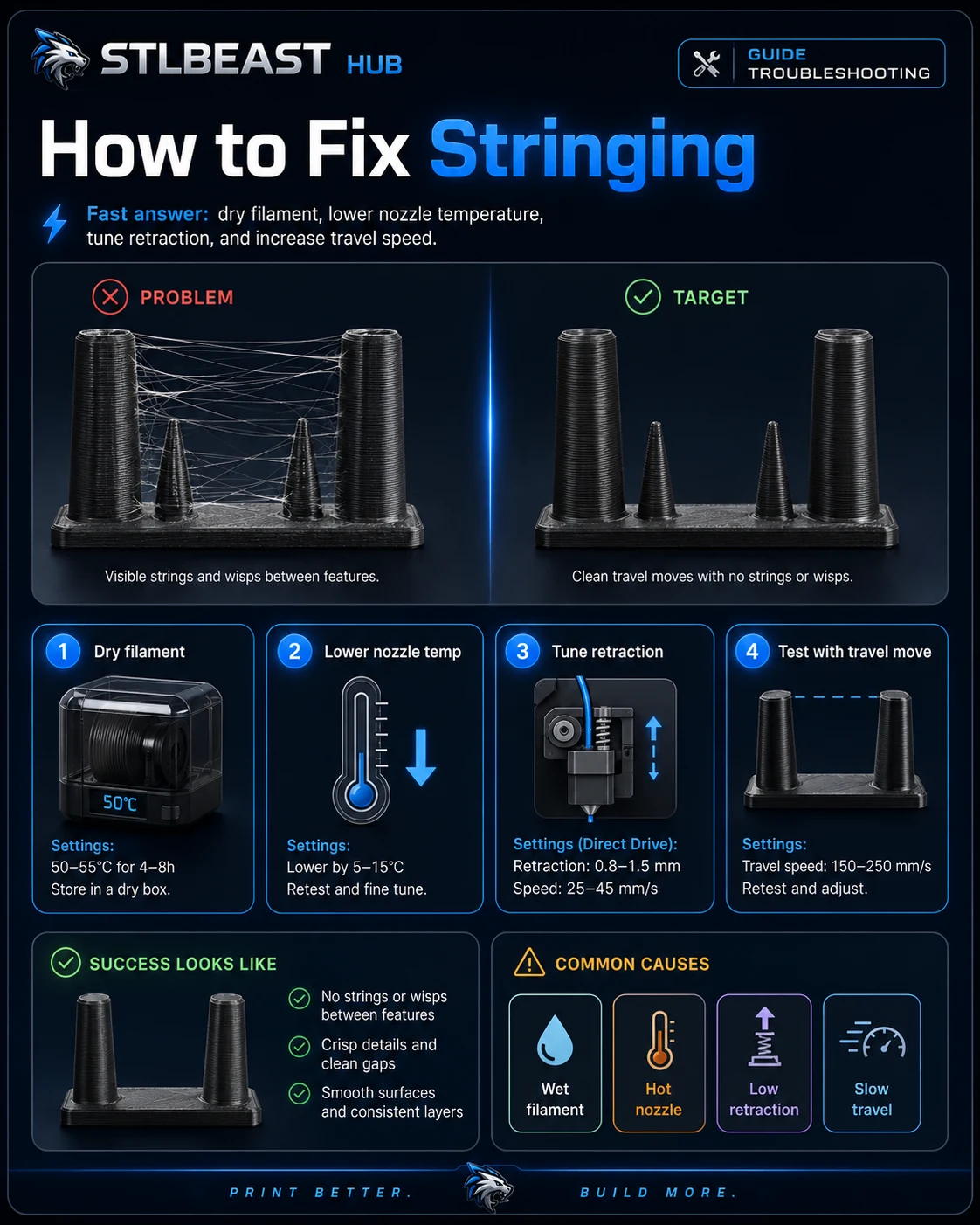 StringingHow to Fix Stringing in 3D Prints
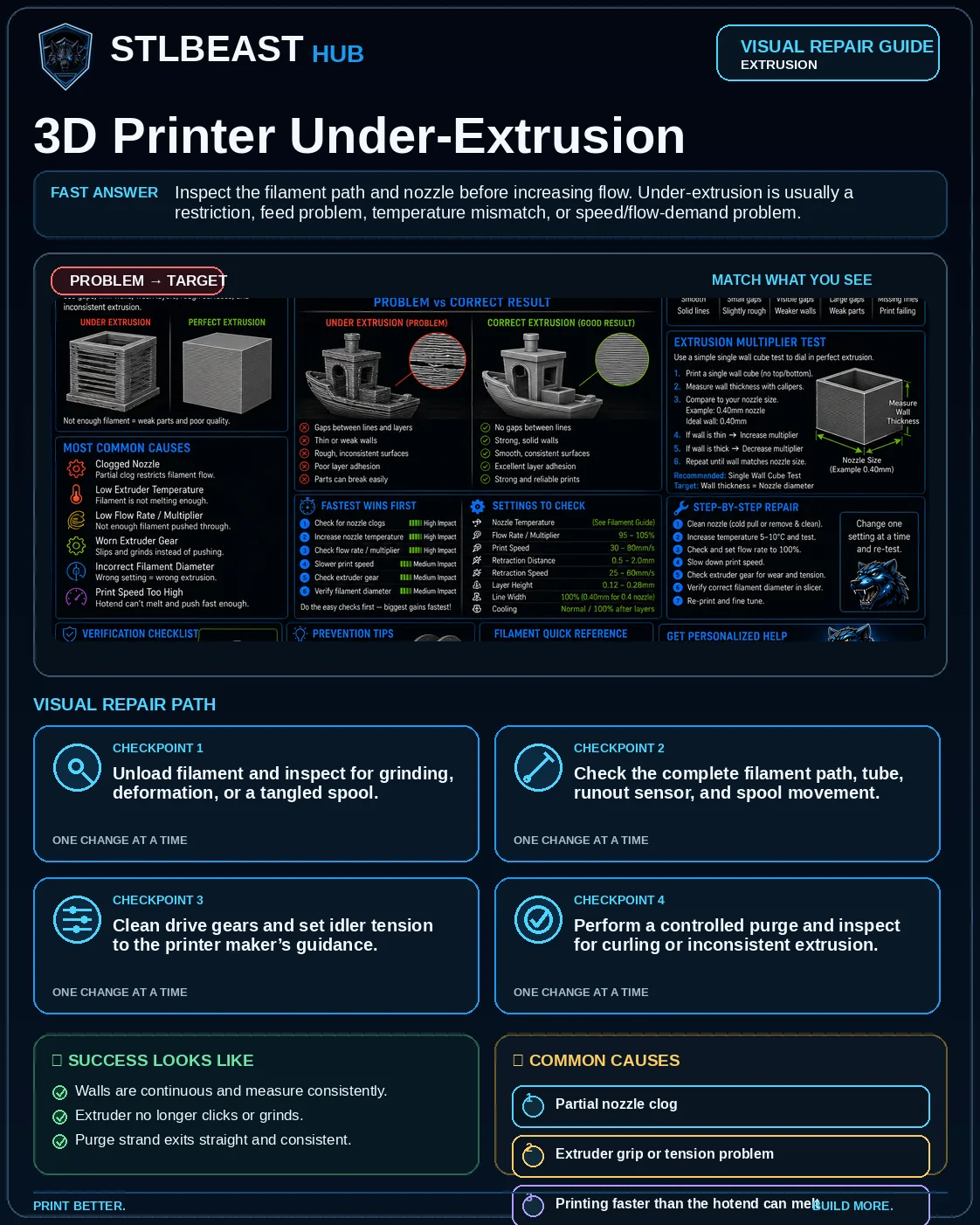 Extrusion3D Printer Under-Extrusion
 ExtrusionHeat Creep Jam Fix