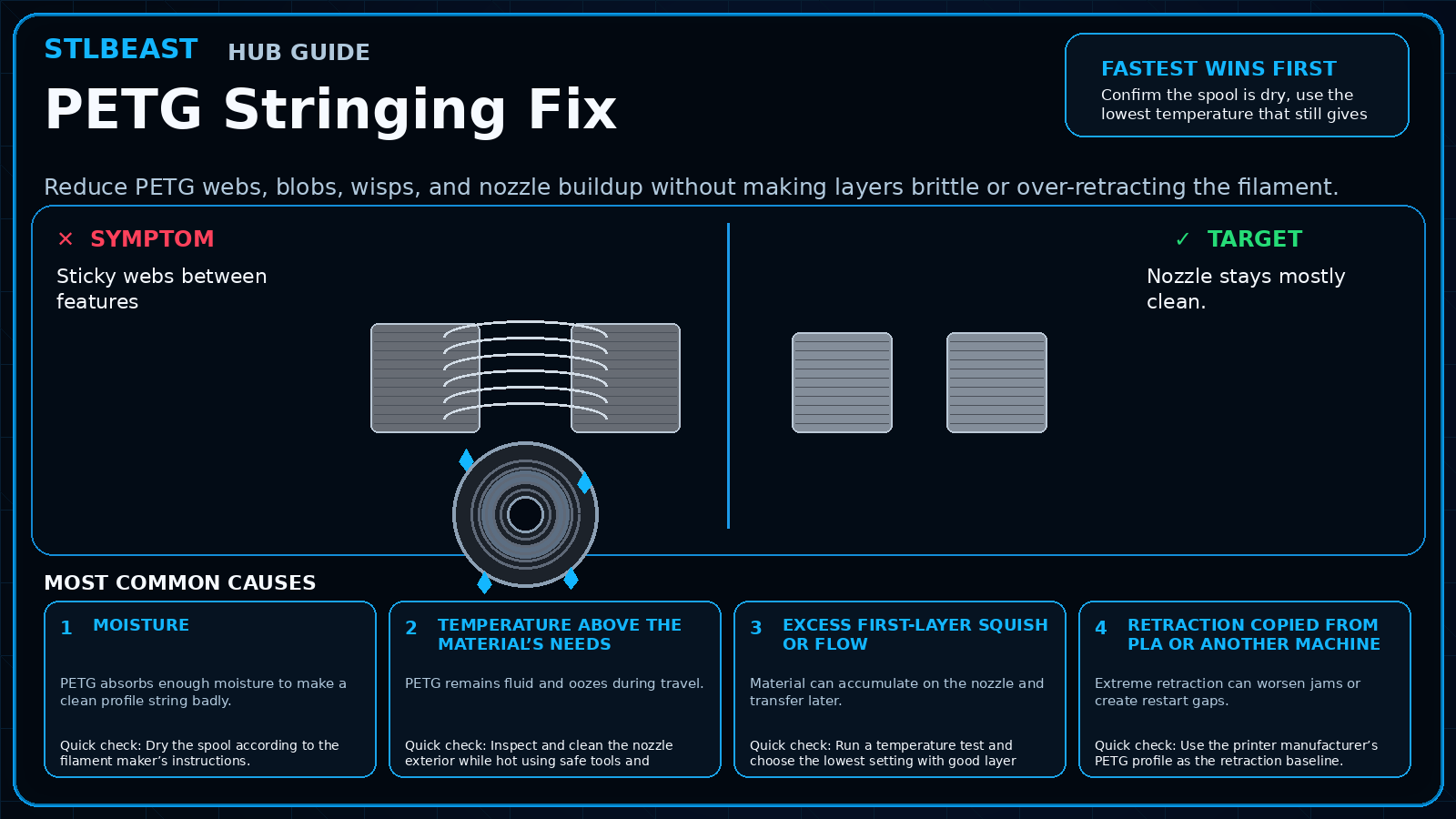
Reduce PETG webs, blobs, wisps, and nozzle buildup without making layers brittle or over-retracting the filament.
Start hereConfirm the spool is dry, use the lowest temperature that still gives strong bonding, and tune conservative retraction from the printer profile.
First safe actionRun the first safe check and change one variable at a time.
Proof targetA small representative test no longer shows the original symptom.
Match the failed area to the visual before changing a setting.
Repair progress0 of 7 complete
Step 1 of 7
Dry the spool according to the filament maker’s instructions.
Keep the problem and target visual open while you make this change.
Why this matters
PETG absorbs enough moisture to make a clean profile string badly.
Setting or checkTemperature
Reduce in small increments while checking layer strength.
Expected result
Nozzle stays mostly clean.
Step 2 of 7
Inspect and clean the nozzle exterior while hot using safe tools and procedures.
Keep the problem and target visual open while you make this change.
Why this matters
PETG remains fluid and oozes during travel.
Setting or checkRetraction
Keep conservative, especially on all-metal hotends and direct-drive systems.
Expected result
Travel webs are minimal.
Step 3 of 7
Run a temperature test and choose the lowest setting with good layer bonding.
Keep the problem and target visual open while you make this change.
Why this matters
Material can accumulate on the nozzle and transfer later.
Setting or checkFan
Use enough for detail without weakening layers.
Expected result
Restart points are full, not starved.
Step 4 of 7
Use the printer manufacturer’s PETG profile as the retraction baseline.
Keep the problem and target visual open while you make this change.
Why this matters
Extreme retraction can worsen jams or create restart gaps.
Setting or checkFirst layer
Use less squish than many PLA profiles.
Expected result
Layer adhesion remains strong.
Step 5 of 7
Tune distance and speed separately in small steps.
Keep the problem and target visual open while you make this change.
Why this matters
Residue and leakage create unpredictable blobs.
Setting or checkTemperature
Reduce in small increments while checking layer strength.
Expected result
Nozzle stays mostly clean.
Step 6 of 7
Reduce excessive first-layer squish and confirm flow.
Keep the problem and target visual open while you make this change.
Why this matters
PETG absorbs enough moisture to make a clean profile string badly.
Setting or checkRetraction
Keep conservative, especially on all-metal hotends and direct-drive systems.
Expected result
Travel webs are minimal.
Step 7 of 7
Use wipe/travel-avoidance only after the core settings are stable.
Keep the problem and target visual open while you make this change.
Why this matters
PETG remains fluid and oozes during travel.
Setting or checkFan
Use enough for detail without weakening layers.
Expected result
Restart points are full, not starved.
Controlled test log
Change one variable, then record what happened
This keeps temperature, retraction, speed, mechanical, and material tests from blending together. The history stays private in this browser.

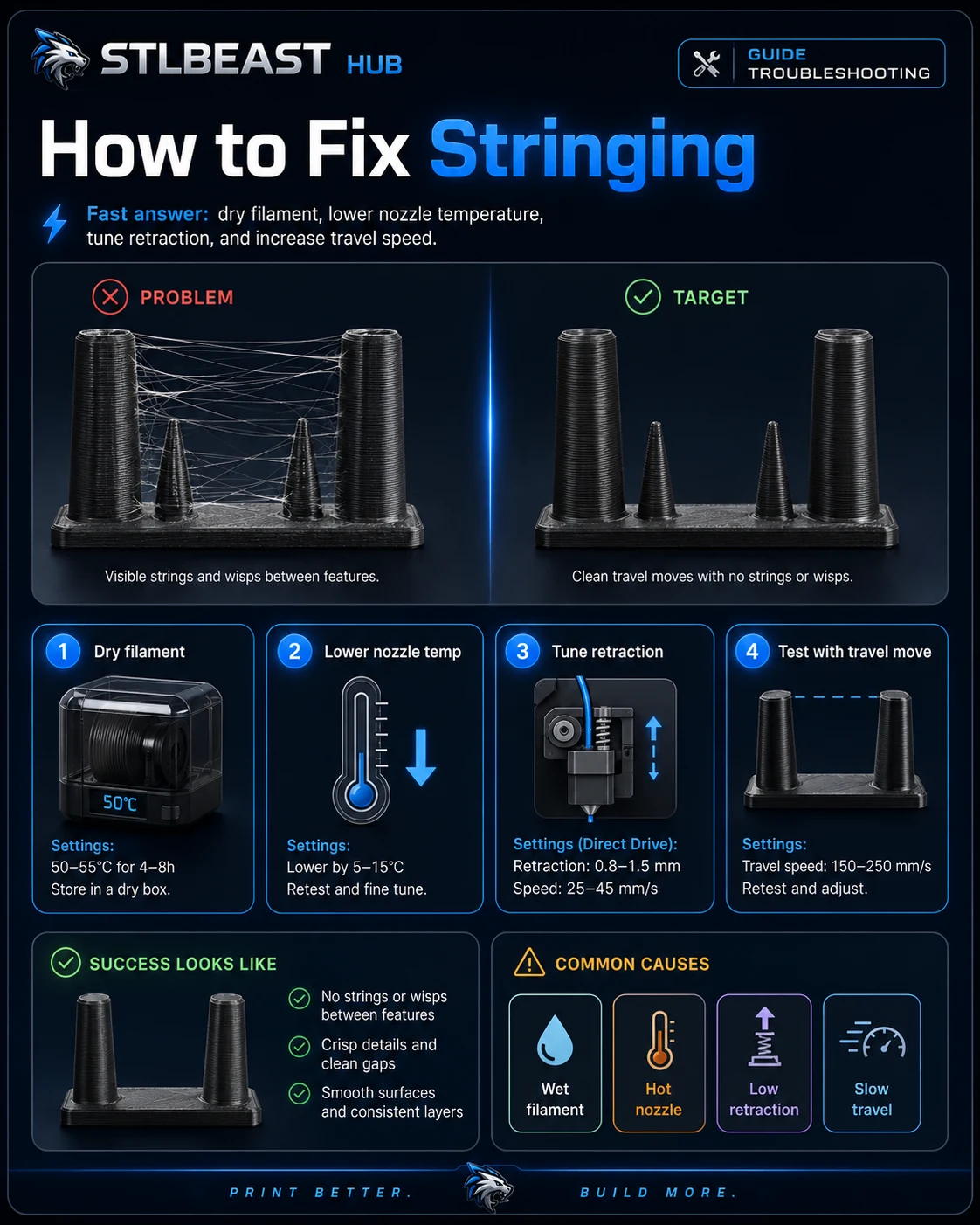 StringingHow to Fix Stringing in 3D Prints
 MaterialsWet Filament Symptoms and Drying
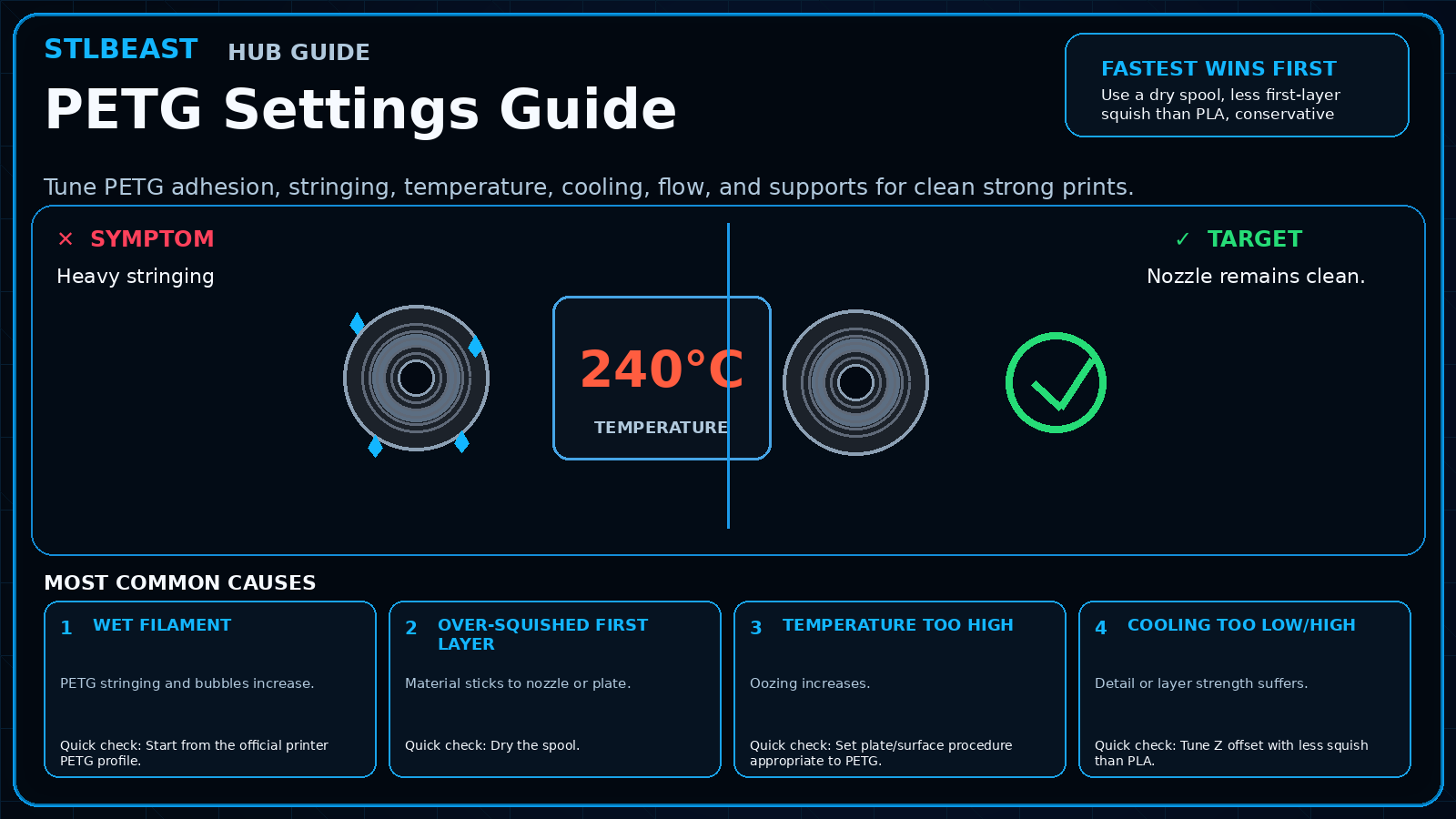 Material SettingsPETG Settings Guide