Dimensional Accuracy and Fit Tolerance
Fix holes that print too small, pegs that are too large, and multipart designs that do not fit.
- Keyword match
- Direct-answer match
- Likely-cause match
Use normal language such as “hairy PETG print,” “clicking extruder and thin lines,” or “resin part stuck to the film.” The engine translates common descriptions into technical causes and explains why each answer matched.
Results are ranked by symptom, title, cause and equipment context.
Fix holes that print too small, pegs that are too large, and multipart designs that do not fit.
A detailed STLBEAST repair guide to design and tune functional threads for the process. Learn how to recognize the symptom, rank the likely causes, apply safe fixes in order, verify the result, and prevent the failure from returning.
A reliable workflow for manual leveling, bed mesh, probe checks, gantry alignment, and first-layer calibration.
Choose realistic speeds for walls, infill, overhangs, bridges, and volumetric flow.
Design the correct pilot hole and surrounding wall, use a temperature-controlled insertion tool, press straight without force, stop at depth, and let the joint.
A detailed STLBEAST repair guide to create reliable internal dimensions for functional parts. Learn how to recognize the symptom, rank the likely causes, apply safe fixes in order, verify the result, and prevent the failure from returning.
Run the printer manufacturer’s PID or heater calibration only after the heater, sensor, wiring, fans, and hotend assembly are confirmed healthy.
Fix first-layer squish, flow, seam blobs, clearance, support intrusion, and cooling, then verify with a small print-in-place calibration model.
Calibrate printer dimensions, material flex, clearance, layer orientation, and hook geometry using a small test coupon before reprinting the full assembly.
A detailed STLBEAST repair guide to correct mechanical geometry before calibration. Learn how to recognize the symptom, rank the likely causes, apply safe fixes in order, verify the result, and prevent the failure from returning.
A detailed STLBEAST repair guide to use abrasive filled materials without sacrificing flow or hardware. Learn how to recognize the symptom, rank the likely causes, apply safe fixes in order, verify the result, and prevent the failure from returning.
A detailed STLBEAST repair guide to replace a nozzle without leaks, thread damage, or wrong Z offset. Learn how to recognize the symptom, rank the likely causes, apply safe fixes in order, verify the result, and prevent the failure from returning.
A detailed STLBEAST repair guide to control moisture, warping, and adhesion for nylon. Learn how to recognize the symptom, rank the likely causes, apply safe fixes in order, verify the result, and prevent the failure from returning.
A detailed STLBEAST repair guide to print high-temperature material within machine limits. Learn how to recognize the symptom, rank the likely causes, apply safe fixes in order, verify the result, and prevent the failure from returning.
Tune enclosure, bed adhesion, temperature, cooling, and ventilation for high-shrink materials.
A detailed STLBEAST repair guide to use a cube to diagnose dimensions, walls, corners, and motion. Learn how to recognize the symptom, rank the likely causes, apply safe fixes in order, verify the result, and prevent the failure from returning.
A detailed STLBEAST repair guide to remove soft contamination using a controlled pull. Learn how to recognize the symptom, rank the likely causes, apply safe fixes in order, verify the result, and prevent the failure from returning.
A detailed STLBEAST repair guide to find the support controls that matter most in Cura. Learn how to recognize the symptom, rank the likely causes, apply safe fixes in order, verify the result, and prevent the failure from returning.
A detailed STLBEAST repair guide to measure whether inconsistent stock is causing changing extrusion. Learn how to recognize the symptom, rank the likely causes, apply safe fixes in order, verify the result, and prevent the failure from returning.
A detailed STLBEAST repair guide to divide a model into strong, alignable parts that fit the build volume. Learn how to recognize the symptom, rank the likely causes, apply safe fixes in order, verify the result, and prevent the failure from returning.
A detailed STLBEAST repair guide to tune normal or tree supports using OrcaSlicer preview and interface controls. Learn how to recognize the symptom, rank the likely causes, apply safe fixes in order, verify the result, and prevent the failure from returning.
A detailed STLBEAST repair guide to use branching supports effectively on complex figures and organic forms. Learn how to recognize the symptom, rank the likely causes, apply safe fixes in order, verify the result, and prevent the failure from returning.
A detailed STLBEAST repair guide to configure support material, interfaces, and organic supports predictably. Learn how to recognize the symptom, rank the likely causes, apply safe fixes in order, verify the result, and prevent the failure from returning.
A detailed STLBEAST repair guide to tune distance and speed without creating heat creep or grinding. Learn how to recognize the symptom, rank the likely causes, apply safe fixes in order, verify the result, and prevent the failure from returning.
A detailed STLBEAST repair guide to use smooth PEI safely with the right material and release strategy. Learn how to recognize the symptom, rank the likely causes, apply safe fixes in order, verify the result, and prevent the failure from returning.
A detailed STLBEAST repair guide to choose the lowest temperature that gives clean flow and strong bonding. Learn how to recognize the symptom, rank the likely causes, apply safe fixes in order, verify the result, and prevent the failure from returning.
A detailed STLBEAST repair guide to improve textured-plate grip without excessive squish. Learn how to recognize the symptom, rank the likely causes, apply safe fixes in order, verify the result, and prevent the failure from returning.
Tune PETG adhesion, stringing, temperature, cooling, flow, and supports for clean strong prints.
A detailed STLBEAST repair guide to use enough structure without wasting material or making removal difficult. Learn how to recognize the symptom, rank the likely causes, apply safe fixes in order, verify the result, and prevent the failure from returning.
A detailed STLBEAST repair guide to compensate for extrusion, geometry, and material shrink without guessing. Learn how to recognize the symptom, rank the likely causes, apply safe fixes in order, verify the result, and prevent the failure from returning.
Build a reliable PLA baseline for temperature, cooling, speed, retraction, first layer, and strength.
Tune flexible filament speed, feed path, retraction, temperature, and support behavior.
Repair holes, inverted normals, self-intersections, duplicate shells, and broken mesh topology.
Fix corners curling off the bed, base distortion, and large parts shrinking during printing.
Choose a material rated for UV and service temperature, print for layer strength, protect the surface when appropriate, and test the actual environment before r.
Clean, dry, sand, and test the part; apply thin compatible primer coats, inspect defects, sand again if needed, then build colour in light layers.
Start with safe support cleanup, use progressive grits, keep heat and dust controlled, preserve edges, and apply filler or primer only after the surface is clea.
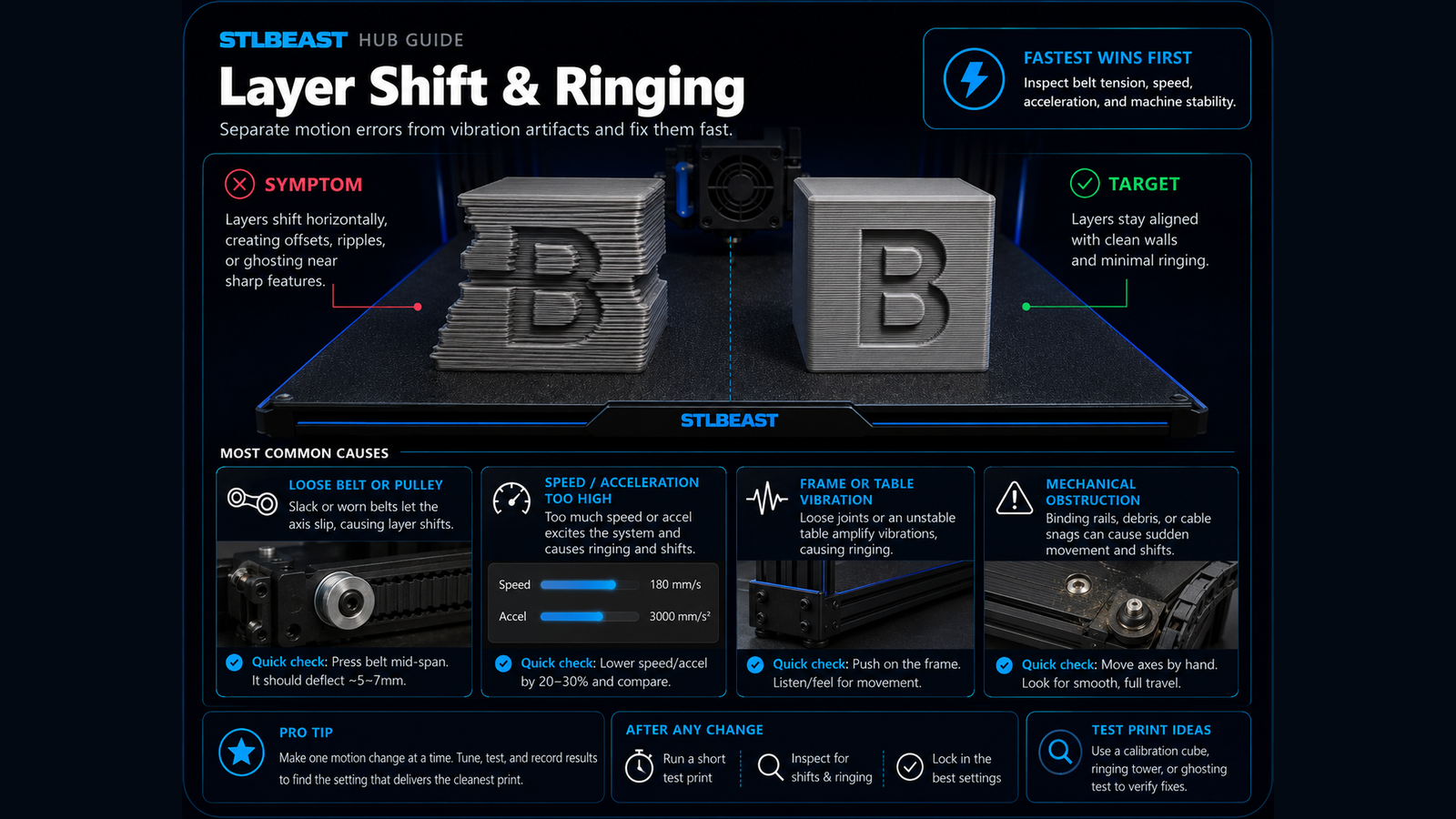
Fix sudden sideways offsets, shifted layers, skipped motion, and prints that move out of alignment.
Check power input, supply voltage, loose connectors, overheated electronics, shorts, heater wiring, and corrupted files before attempting another long print.
Fix poor bed adhesion, lifting first layers, loose corners, and prints that detach from the build plate.
Fix thin walls, missing lines, weak layers, gaps, and inconsistent flow.
Dry-fit and align parts first, prepare clean mating surfaces, choose an adhesive compatible with the material and joint load, clamp without distortion, and allo.
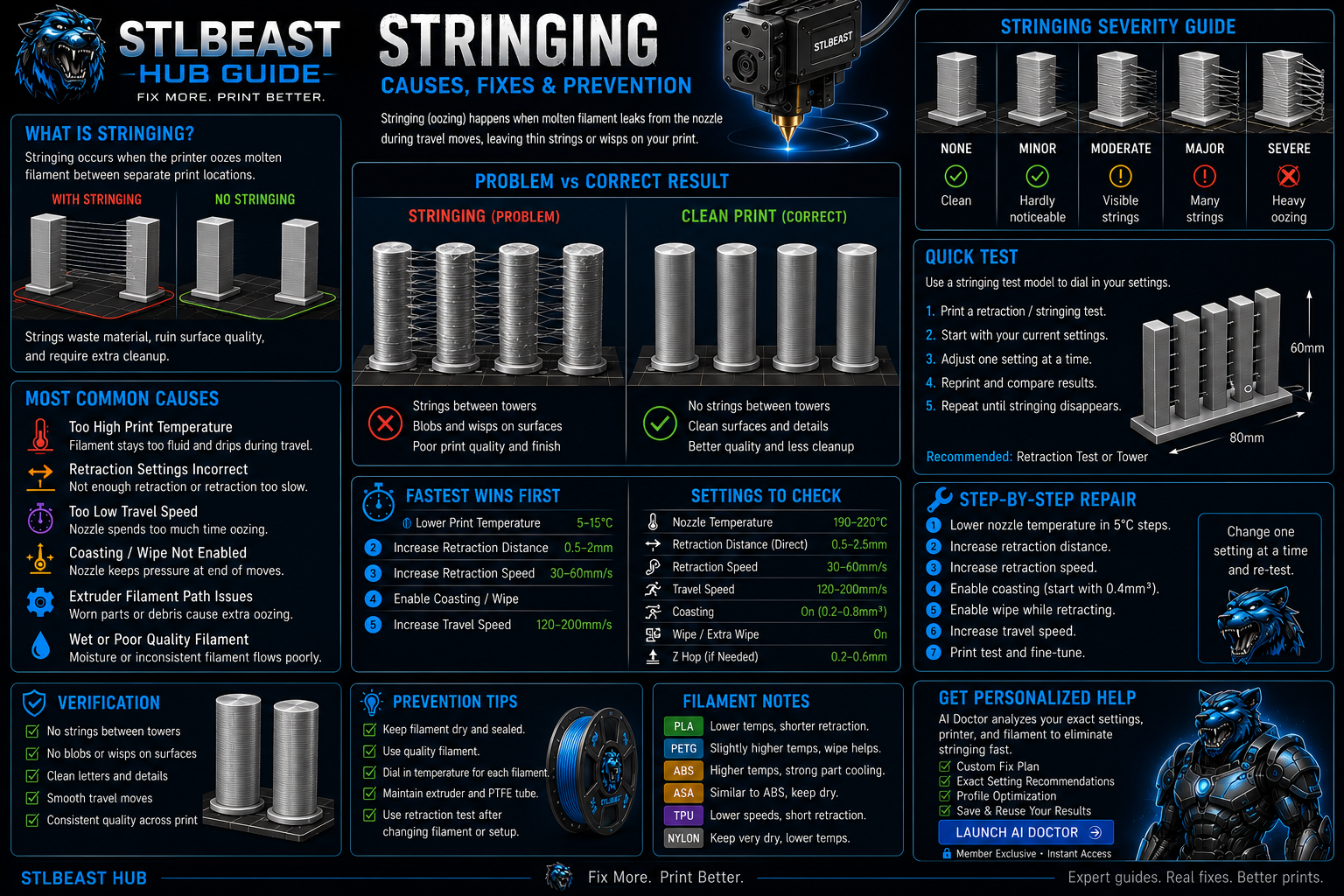
Stop fine hairs, heavy webs, oozing, and travel strings by testing moisture, temperature, retraction, and travel behavior in the right order.
Increase continuous walls and bottom layers, correct under-extrusion and seams, orient to reduce leak paths, and pressure-test safely before using the part.
A detailed STLBEAST repair guide to restore smooth vertical travel and prevent banding or missed layers. Learn how to recognize the symptom, rank the likely causes, apply safe fixes in order, verify the result, and prevent the failure from returning.
A detailed STLBEAST repair guide to separate harmless travel sounds from real collision risk. Learn how to recognize the symptom, rank the likely causes, apply safe fixes in order, verify the result, and prevent the failure from returning.
Fix prints that detach, shift, collapse, or continue extruding loose filament into a tangled spaghetti failure.
Use a short shielded data cable, disable computer sleep and USB power saving, isolate electrical noise, and prefer local or network printing when the printer su.
Members can connect ranked answers to saved printers, previous failed repairs, full Printer Settings, AI Doctor case history and community-confirmed configurations.