Bed Leveling and Z Offset Guide
A reliable workflow for manual leveling, bed mesh, probe checks, gantry alignment, and first-layer calibration.
- Keyword match
- Symptom match
- Title matches “z offset”
Use normal language such as “hairy PETG print,” “clicking extruder and thin lines,” or “resin part stuck to the film.” The engine translates common descriptions into technical causes and explains why each answer matched.
Results are ranked by symptom, title, cause and equipment context.
A reliable workflow for manual leveling, bed mesh, probe checks, gantry alignment, and first-layer calibration.
Inspect probe mounting, deployment, wiring, nozzle cleanliness, bed surface, offsets, and firmware configuration before repeating a homing or mesh cycle.
Confirm the mesh was saved, the correct profile is loaded after homing, start G-code does not clear it, and the Z axis visibly compensates during the first laye.
Correct swollen first layers, oversized bottoms, tight holes near the bed, and rounded lower edges.
Fix round, loose first-layer lines, gaps, weak adhesion, and lines that follow the nozzle.
A detailed STLBEAST repair guide to balance cleanliness, temperature, and release on glass. Learn how to recognize the symptom, rank the likely causes, apply safe fixes in order, verify the result, and prevent the failure from returning.
Fix poor bed adhesion, lifting first layers, loose corners, and prints that detach from the build plate.
Identify an over-squished first layer, scraping nozzle, blocked extrusion, ridges, and elephant-foot symptoms.
A detailed STLBEAST repair guide to calibrate volume only after Z offset and leveling are correct. Learn how to recognize the symptom, rank the likely causes, apply safe fixes in order, verify the result, and prevent the failure from returning.
A detailed STLBEAST repair guide to tune the two most important first-layer process settings. Learn how to recognize the symptom, rank the likely causes, apply safe fixes in order, verify the result, and prevent the failure from returning.
A detailed STLBEAST repair guide to remove raised ridges while preserving adhesion. Learn how to recognize the symptom, rank the likely causes, apply safe fixes in order, verify the result, and prevent the failure from returning.
A detailed STLBEAST repair guide to improve textured-plate grip without excessive squish. Learn how to recognize the symptom, rank the likely causes, apply safe fixes in order, verify the result, and prevent the failure from returning.
Fix prints that detach, shift, collapse, or continue extruding loose filament into a tangled spaghetti failure.
Inspect the bed cable, connector, heater, thermistor, power delivery, mounting, and insulation before compensating with higher temperatures.
A detailed STLBEAST repair guide to close visible gaps without crushing the first layer. Learn how to recognize the symptom, rank the likely causes, apply safe fixes in order, verify the result, and prevent the failure from returning.
A detailed STLBEAST repair guide to stabilize extrusion and nozzle height across the plate. Learn how to recognize the symptom, rank the likely causes, apply safe fixes in order, verify the result, and prevent the failure from returning.
Clean the plate and screen area, loosen the plate as specified, home against the approved leveling surface, square the plate, tighten evenly, and set zero only.
Fix corners curling off the bed, base distortion, and large parts shrinking during printing.
A detailed STLBEAST repair guide to remove play that destabilizes layers and first-layer height. Learn how to recognize the symptom, rank the likely causes, apply safe fixes in order, verify the result, and prevent the failure from returning.
Run the printer manufacturer’s PID or heater calibration only after the heater, sensor, wiring, fans, and hotend assembly are confirmed healthy.
Separate removable-sheet, bed, magnet, mounting, and mesh errors; reseat components, remove debris, avoid over-constraining mounts, and replace permanently dist.
Clean the pin, verify free movement, inspect the mount and wiring, run the built-in self-test, and confirm the correct probe type and signal logic.
Improve lines printed across gaps, drooping bridge strands, and rough unsupported ceilings.
A detailed STLBEAST repair guide to choose the least intrusive adhesion aid that solves the geometry problem. Learn how to recognize the symptom, rank the likely causes, apply safe fixes in order, verify the result, and prevent the failure from returning.
A detailed STLBEAST repair guide to eliminate trapped bubbles and inconsistent bonding. Learn how to recognize the symptom, rank the likely causes, apply safe fixes in order, verify the result, and prevent the failure from returning.
A detailed STLBEAST repair guide to control shrinkage across wide flat parts. Learn how to recognize the symptom, rank the likely causes, apply safe fixes in order, verify the result, and prevent the failure from returning.
Build a reliable PLA baseline for temperature, cooling, speed, retraction, first layer, and strength.
Choose orientation for strength, supports, surface quality, stability, and fit.
A detailed STLBEAST repair guide to calibrate tower geometry, endstops, and bed plane systematically. Learn how to recognize the symptom, rank the likely causes, apply safe fixes in order, verify the result, and prevent the failure from returning.
A detailed STLBEAST repair guide to use smooth PEI safely with the right material and release strategy. Learn how to recognize the symptom, rank the likely causes, apply safe fixes in order, verify the result, and prevent the failure from returning.
Tune PETG adhesion, stringing, temperature, cooling, flow, and supports for clean strong prints.
Diagnose inconsistent extrusion, curled purge strands, missing layers, and a nozzle that stops flowing.
Reduce PETG webs, blobs, wisps, and nozzle buildup without making layers brittle or over-retracting the filament.
A detailed STLBEAST repair guide to remove absorbed moisture without deforming the spool or polymer. Learn how to recognize the symptom, rank the likely causes, apply safe fixes in order, verify the result, and prevent the failure from returning.
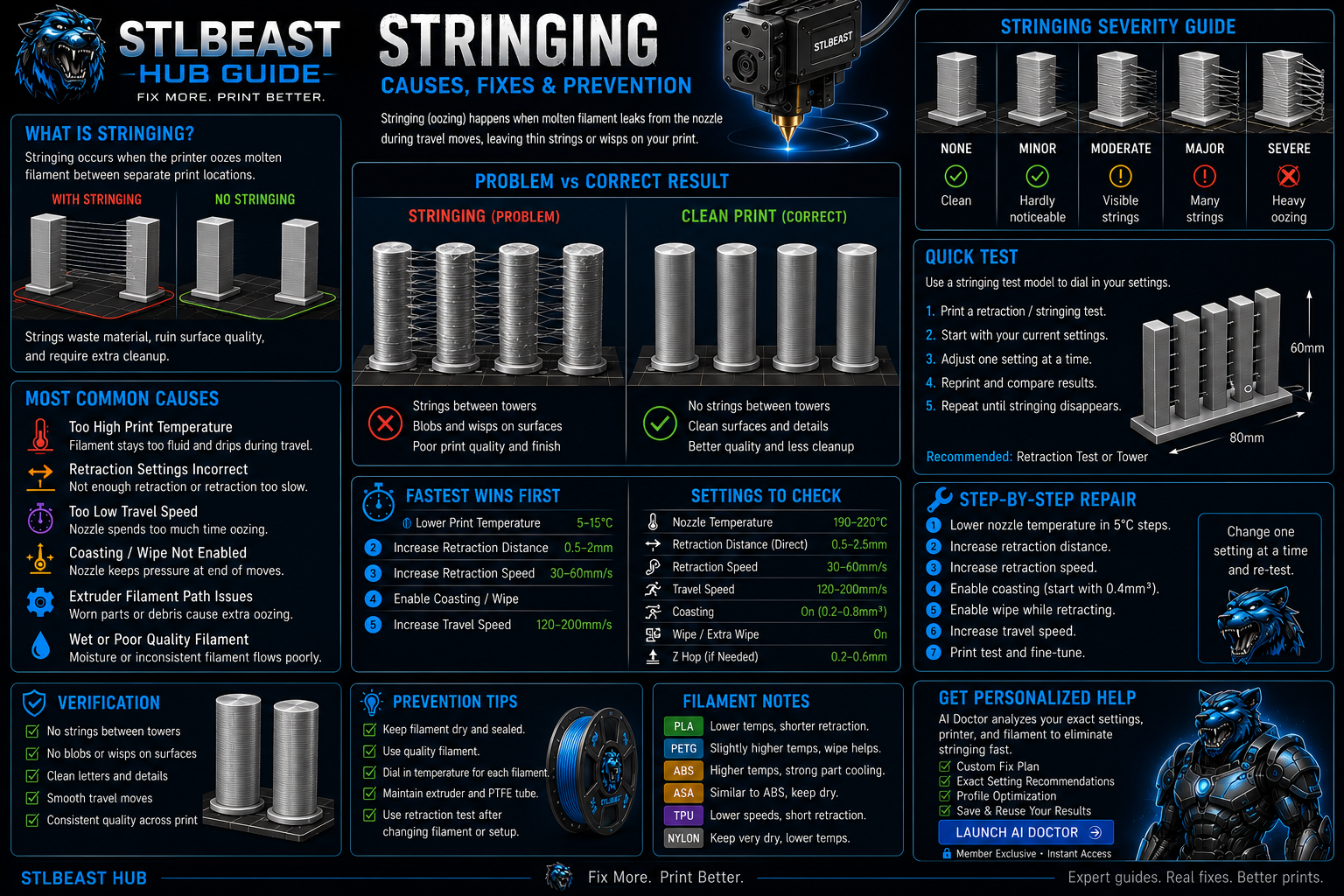
Stop fine hairs, heavy webs, oozing, and travel strings by testing moisture, temperature, retraction, and travel behavior in the right order.
A detailed STLBEAST repair guide to find every disconnected region before printing. Learn how to recognize the symptom, rank the likely causes, apply safe fixes in order, verify the result, and prevent the failure from returning.
Reduce echo lines after corners, ripples around text, and vibration artifacts on outer walls.
A detailed STLBEAST repair guide to control where perimeter starts and ends are placed. Learn how to recognize the symptom, rank the likely causes, apply safe fixes in order, verify the result, and prevent the failure from returning.
Fix prints that start normally and then lose extrusion, especially with PLA in warm enclosures.
Tune enclosure, bed adhesion, temperature, cooling, and ventilation for high-shrink materials.
A detailed STLBEAST repair guide to use enough structure without wasting material or making removal difficult. Learn how to recognize the symptom, rank the likely causes, apply safe fixes in order, verify the result, and prevent the failure from returning.
A detailed STLBEAST repair guide to find intermittent restrictions and feed variation. Learn how to recognize the symptom, rank the likely causes, apply safe fixes in order, verify the result, and prevent the failure from returning.
A detailed STLBEAST repair guide to replace a nozzle without leaks, thread damage, or wrong Z offset. Learn how to recognize the symptom, rank the likely causes, apply safe fixes in order, verify the result, and prevent the failure from returning.
Fix first-layer squish, flow, seam blobs, clearance, support intrusion, and cooling, then verify with a small print-in-place calibration model.
Improve the tower’s first layer, width, cooling, speed, and placement, then reduce unnecessary tool changes or use a safer purge strategy.
Stop the machine, disconnect power after it cools, and inspect the heater, thermistor, wiring, connectors, hotend assembly, and firmware limits before attemptin.
A detailed STLBEAST repair guide to control moisture, warping, and adhesion for nylon. Learn how to recognize the symptom, rank the likely causes, apply safe fixes in order, verify the result, and prevent the failure from returning.
Calibrate average extrusion without hiding clogs, incorrect Z offset, or hotend-capacity limits.
Members can connect ranked answers to saved printers, previous failed repairs, full Printer Settings, AI Doctor case history and community-confirmed configurations.