Print-in-Place Hinges or Moving Parts Fused
Fix first-layer squish, flow, seam blobs, clearance, support intrusion, and cooling, then verify with a small print-in-place calibration model.
- Title matches “in”
- Keyword match
- Symptom match
Use normal language such as “hairy PETG print,” “clicking extruder and thin lines,” or “resin part stuck to the film.” The engine translates common descriptions into technical causes and explains why each answer matched.
Results are ranked by symptom, title, cause and equipment context.
Fix first-layer squish, flow, seam blobs, clearance, support intrusion, and cooling, then verify with a small print-in-place calibration model.
Stop printing, clean the hotend, and reinstall the nozzle using the manufacturer hot-tightening procedure so the nozzle seals against the heatbreak—not merely t.
A detailed STLBEAST repair guide to create reliable internal dimensions for functional parts. Learn how to recognize the symptom, rank the likely causes, apply safe fixes in order, verify the result, and prevent the failure from returning.
A detailed STLBEAST repair guide to control where perimeter starts and ends are placed. Learn how to recognize the symptom, rank the likely causes, apply safe fixes in order, verify the result, and prevent the failure from returning.
A detailed STLBEAST repair guide to design and tune functional threads for the process. Learn how to recognize the symptom, rank the likely causes, apply safe fixes in order, verify the result, and prevent the failure from returning.
A detailed STLBEAST repair guide to replace a nozzle without leaks, thread damage, or wrong Z offset. Learn how to recognize the symptom, rank the likely causes, apply safe fixes in order, verify the result, and prevent the failure from returning.
A detailed STLBEAST repair guide to divide a model into strong, alignable parts that fit the build volume. Learn how to recognize the symptom, rank the likely causes, apply safe fixes in order, verify the result, and prevent the failure from returning.
A detailed STLBEAST repair guide to find the support controls that matter most in Cura. Learn how to recognize the symptom, rank the likely causes, apply safe fixes in order, verify the result, and prevent the failure from returning.
A detailed STLBEAST repair guide to prevent trapped pressure and uncured resin in hollow models. Learn how to recognize the symptom, rank the likely causes, apply safe fixes in order, verify the result, and prevent the failure from returning.
A detailed STLBEAST repair guide to reduce overgrown bottom layers while preserving plate adhesion. Learn how to recognize the symptom, rank the likely causes, apply safe fixes in order, verify the result, and prevent the failure from returning.
A detailed STLBEAST repair guide to keep viscosity and cure response within the resin maker range. Learn how to recognize the symptom, rank the likely causes, apply safe fixes in order, verify the result, and prevent the failure from returning.
Calibrate printer dimensions, material flex, clearance, layer orientation, and hook geometry using a small test coupon before reprinting the full assembly.
Power down, remove mechanical load, inspect belts, lead screws, connectors, motor wiring, driver current, and axis binding before commanding more movement.
Fix holes that print too small, pegs that are too large, and multipart designs that do not fit.
A detailed STLBEAST repair guide to correct mechanical geometry before calibration. Learn how to recognize the symptom, rank the likely causes, apply safe fixes in order, verify the result, and prevent the failure from returning.
Identify enlarged or damaged nozzle openings, soft detail, inconsistent line width, and abrasion damage.
Run the manufacturer exposure test with the vat removed, inspect the screen and cable, separate protector damage from LCD failure, and replace only with a compa.
Separate removable-sheet, bed, magnet, mounting, and mesh errors; reseat components, remove debris, avoid over-constraining mounts, and replace permanently dist.
Replace worn coupler teeth or damaged PTFE, fully seat the tube against the internal stop, install the locking clip, and remove excessive feed resistance.
Drain and filter the resin, clean the vat safely, inspect the release film under good light, and replace it when cloudy, deeply scratched, loose, creased, or pu.
Stop long prints until the heatsink fan is restored; clean the fan, check its connector and voltage, confirm firmware control, and replace a noisy or stalled un.
Improve the tower’s first layer, width, cooling, speed, and placement, then reduce unnecessary tool changes or use a safer purge strategy.
Stop the printer, protect yourself, contain uncured resin, remove the vat without spreading the leak, inspect the film and screen protector, and replace damaged.
Design the correct pilot hole and surrounding wall, use a temperature-controlled insertion tool, press straight without force, stop at depth, and let the joint.
A detailed STLBEAST repair guide to separate harmless travel sounds from real collision risk. Learn how to recognize the symptom, rank the likely causes, apply safe fixes in order, verify the result, and prevent the failure from returning.
Fix prints that detach, shift, collapse, or continue extruding loose filament into a tangled spaghetti failure.
Confirm the mesh was saved, the correct profile is loaded after homing, start G-code does not clear it, and the Z axis visibly compensates during the first laye.
A detailed STLBEAST repair guide to close visible gaps without crushing the first layer. Learn how to recognize the symptom, rank the likely causes, apply safe fixes in order, verify the result, and prevent the failure from returning.
Fix horizontal cracks, layers splitting apart, and brittle prints with poor interlayer bonding.
A detailed STLBEAST repair guide to stop molten plastic leaking above the nozzle. Learn how to recognize the symptom, rank the likely causes, apply safe fixes in order, verify the result, and prevent the failure from returning.
Improve surfaces above supports, reduce pitting, and protect visible detail.
Stop the machine, disconnect power after it cools, and inspect the heater, thermistor, wiring, connectors, hotend assembly, and firmware limits before attemptin.
Fix poor bed adhesion, lifting first layers, loose corners, and prints that detach from the build plate.
Fix corners curling off the bed, base distortion, and large parts shrinking during printing.
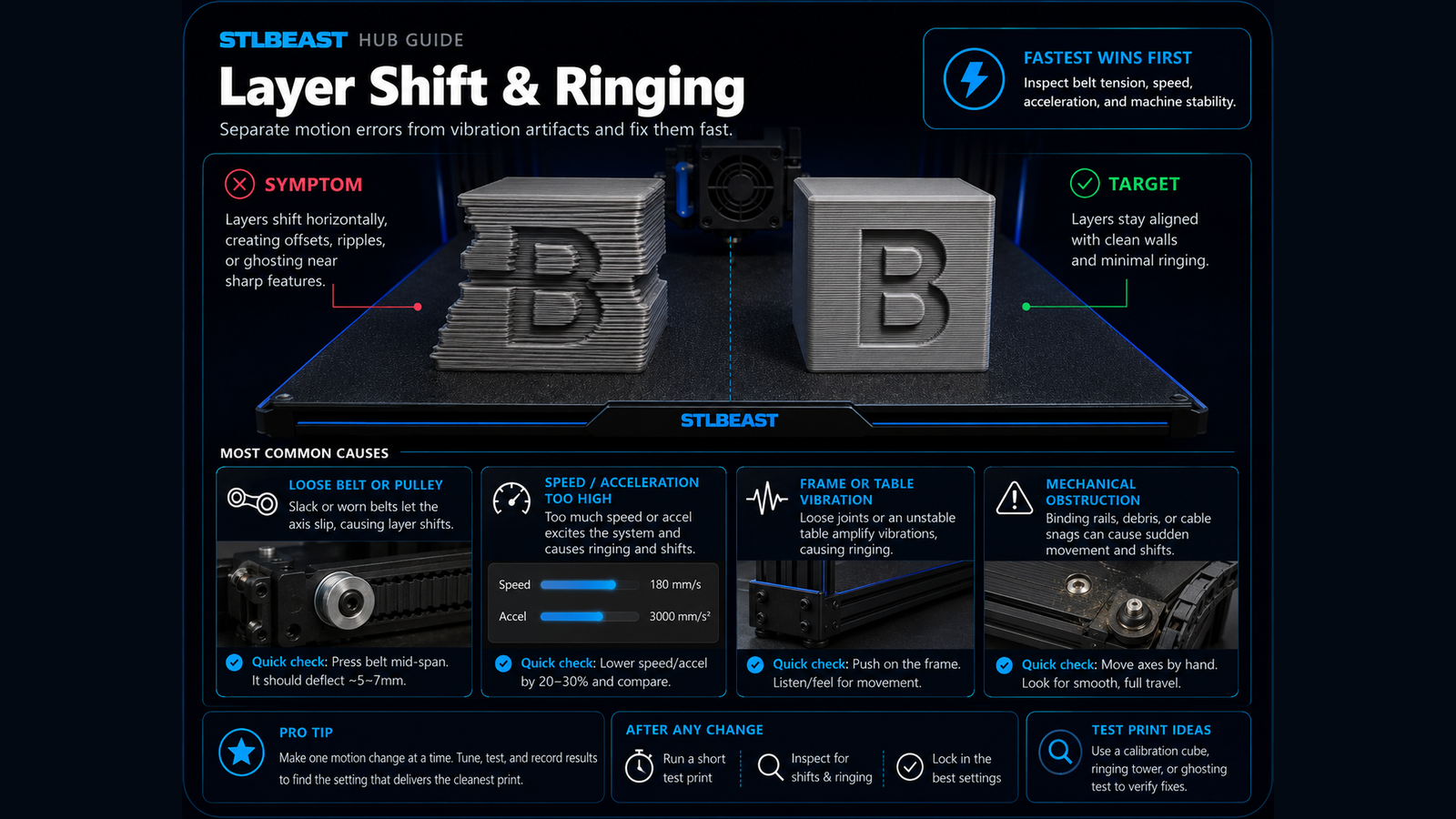
Fix sudden sideways offsets, shifted layers, skipped motion, and prints that move out of alignment.
Check power input, supply voltage, loose connectors, overheated electronics, shorts, heater wiring, and corrupted files before attempting another long print.
Fix thin walls, missing lines, weak layers, gaps, and inconsistent flow.
Choose a material rated for UV and service temperature, print for layer strength, protect the surface when appropriate, and test the actual environment before r.
A detailed STLBEAST repair guide to use abrasive filled materials without sacrificing flow or hardware. Learn how to recognize the symptom, rank the likely causes, apply safe fixes in order, verify the result, and prevent the failure from returning.
A detailed STLBEAST repair guide to separate wash residue, water contamination, and over-curing. Learn how to recognize the symptom, rank the likely causes, apply safe fixes in order, verify the result, and prevent the failure from returning.
A detailed STLBEAST repair guide to calibrate tower geometry, endstops, and bed plane systematically. Learn how to recognize the symptom, rank the likely causes, apply safe fixes in order, verify the result, and prevent the failure from returning.
A detailed STLBEAST repair guide to stabilize temperature, speed, and cooling to keep surface finish consistent. Learn how to recognize the symptom, rank the likely causes, apply safe fixes in order, verify the result, and prevent the failure from returning.
Dry-fit and align parts first, prepare clean mating surfaces, choose an adhesive compatible with the material and joint load, clamp without distortion, and allo.
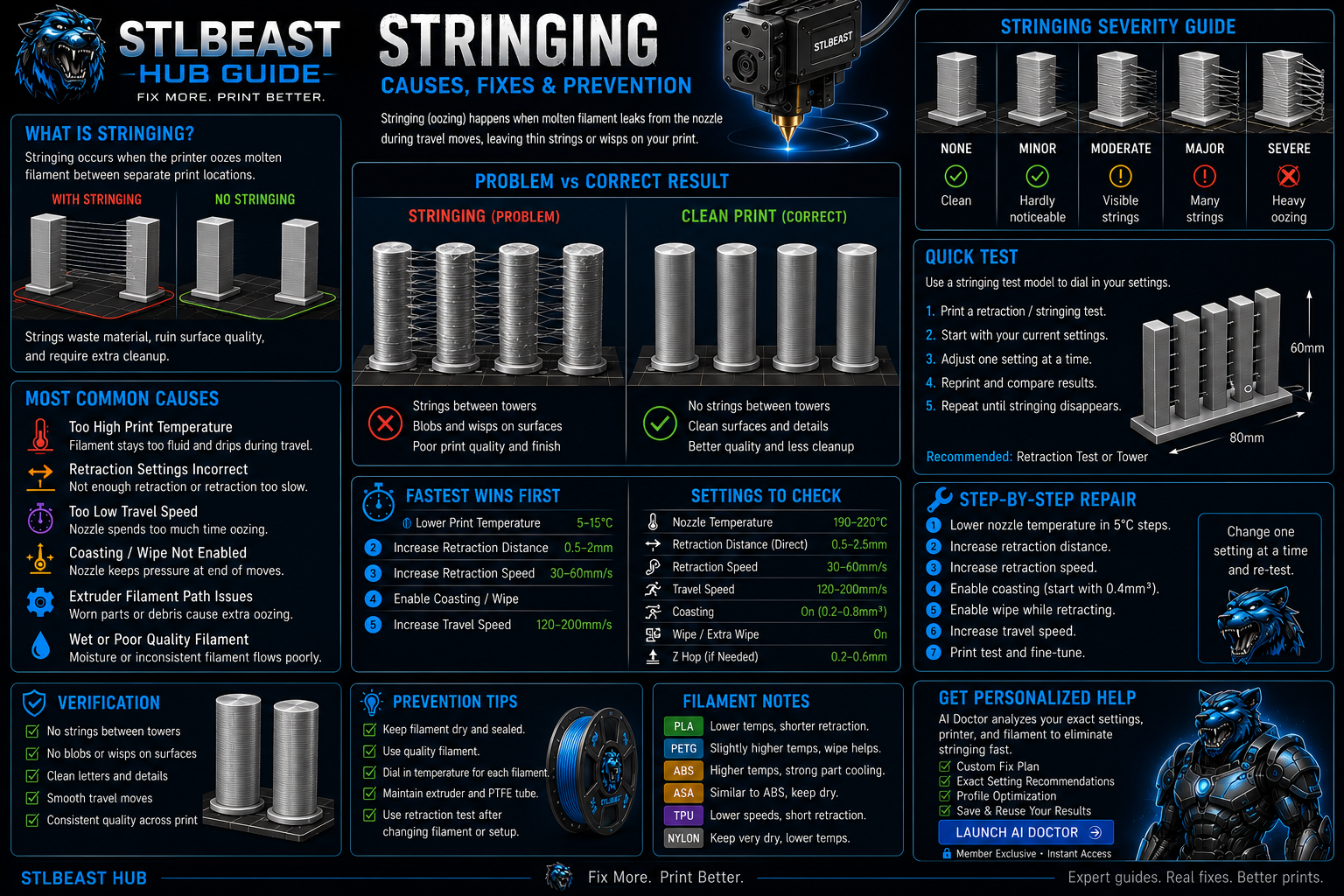
Stop fine hairs, heavy webs, oozing, and travel strings by testing moisture, temperature, retraction, and travel behavior in the right order.
Let the part cool, use the right cutters and direction, remove large branches first, support delicate features, and finish contact marks gradually instead of te.
A detailed STLBEAST repair guide to find intermittent restrictions and feed variation. Learn how to recognize the symptom, rank the likely causes, apply safe fixes in order, verify the result, and prevent the failure from returning.
A detailed STLBEAST repair guide to control shrinkage across wide flat parts. Learn how to recognize the symptom, rank the likely causes, apply safe fixes in order, verify the result, and prevent the failure from returning.
Choose orientation for strength, supports, surface quality, stability, and fit.
Members can connect ranked answers to saved printers, previous failed repairs, full Printer Settings, AI Doctor case history and community-confirmed configurations.